Colorado Springs · Police surveillance technology · 1 October 2026
The county dropped Flock. Colorado Springs’ plate readers now run on Axon.
What a decade of City Council records and the Police Department’s own policies show about the cameras, the money and the data, and what they leave unanswered.
On 30 September El Paso County Sheriff Joe Roybal ended his office’s use of Flock Safety license plate cameras. He sent the company a notice of non-renewal for the nearly two dozen readers in unincorporated El Paso County, citing concerns about the future of Flock’s program and expected state legislation, and said deputies can catch criminals “without relying on Flock cameras” (The Gazette, KKTV, KRDO).
Inside city limits, the Colorado Springs Police Department runs a different system. Its plate reader policy, rewritten in March and again in July, names the vendor for its pole-mounted cameras in one line: “The system used by the department is an Axon system.” Flock does not appear in it.
The Civic Desk searched City Council records back to 2015 and read the seven policies CSPD links from its camera technology page. Here is what they show.
01Who runs the cameras now
CSPD’s Automated License Plate Reader policy (effective 15 July 2026, replacing a version dated 24 March) describes two kinds of readers:
- Fixed readers, mounted on poles: an Axon system.
- Mobile readers, mounted on police vehicles: Axon Fleet, and Leonardo ELSAG readers that run on a Colorado State Patrol server.
The department says it has used plate readers since 2009. The readers capture plates and partial plates, vehicle features such as “decals, top racks, back racks, and toolboxes,” and the date, time, location and direction of travel, and compare them against watch lists.
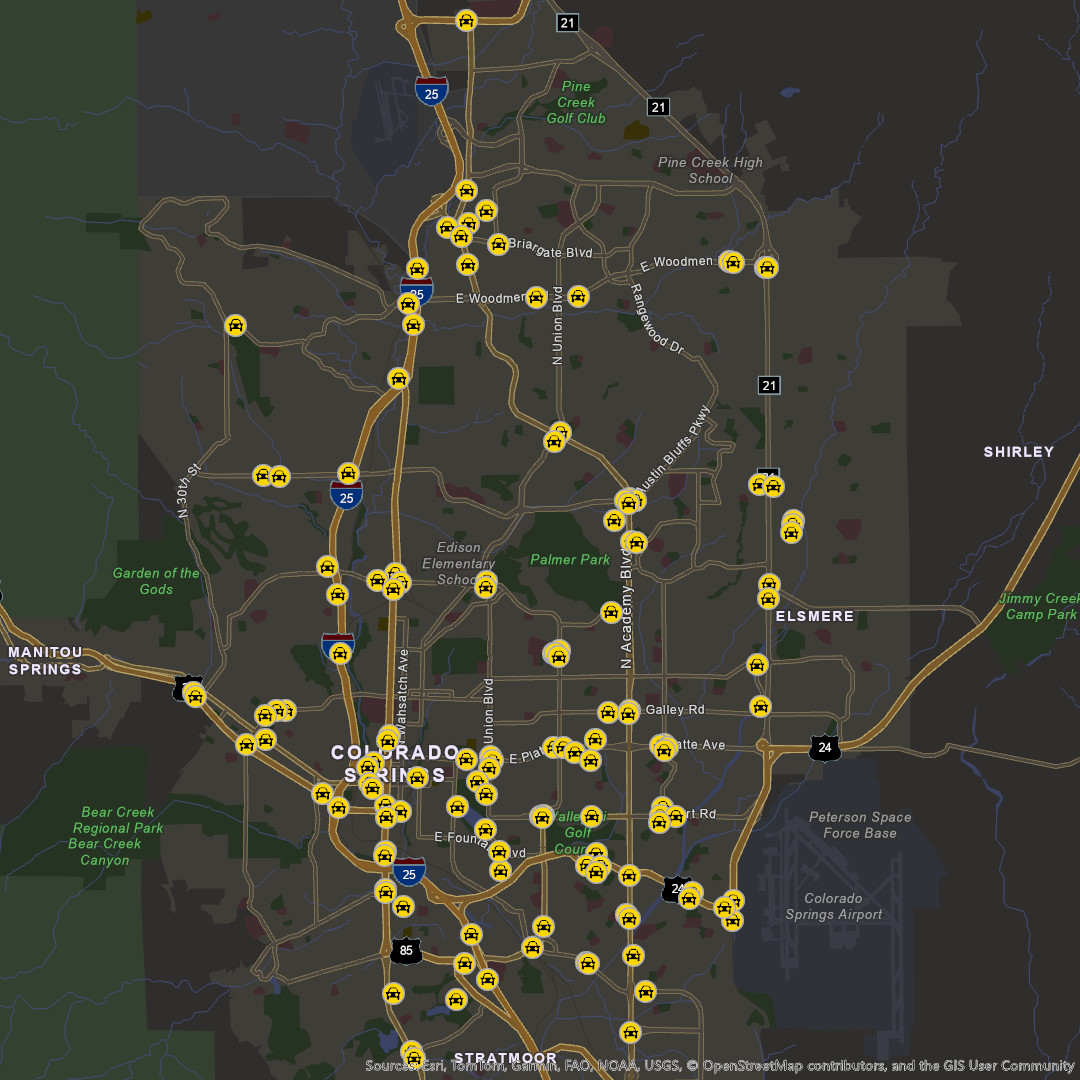
How many? The numbers in circulation
90 Axon readers installed on light posts in March 2026, replacing 55 Flock cameras.Reported by The Gazette, 30 September. No city record we found gives a count or an install date.
Reported, unconfirmed“Over 200” Flock cameras in the city.Said by residents at the 23 July Planning Commission hearing (minutes). It conflicts with The Gazette’s 55.
Reported, unconfirmedCSPD is “nearly tripling” its cameras.A resident citing Fox 21 at City Council, 14 July.
Reported, unconfirmedThe markers on CSPD’s own map clearly outnumber 55.Our reading of the map above. It is not an official count.
From CSPD’s mapWhether the Flock contract has formally ended.The city’s 2026 cost table still listed Flock at $175,000 (see below).
Not in any record02The money Council saw
The only city dollar figures for these systems are on one slide. Slide 7 of the Police Technology Surcharge presentation (file 25-581, Ordinance No. 25-93) lists “2026 major systems costs.” It is a cost table in a fee presentation. It is not a contract.
| System, as the slide names it | 2026 cost |
|---|---|
| Body Worn Camera (Axon) | $744,238 |
| Digital Evidence System & Storage (Axon) | $368,388 |
| AI Transcription & Reporting (Axon) | $834,814 |
| Taser 10 electronic weapon system | $1,200,000 |
| Vehicle Intelligence Cameras (Flock) | $175,000 |
| Records Management System (LERMS) | $530,000 |
| Electronic Citation (Brazos) | $82,496 |
| Total, as stated on the slide | $3,934,936 / year |
- The three rows labeled Axon add up to $1,947,440.
- The Taser row names no vendor. At an October 2025 work session, Deputy Chief John Koch told Council that Axon is “the only company that makes tasers,” and that the department’s Taser contract, $600,000 a year, would cost $1.2 million a year in 2026 (meeting video, about 3 hours 33 minutes in). Counting it brings Axon-related costs to $3,147,440, about 80 percent of the table.
- The largest Axon row is AI transcription and reporting, at $834,814, more than the body cameras themselves. CSPD policy describes two Axon tools that match it, Draft One and Auto-Transcribe (section 05). The slide does not name products.
- The ordinance creates a surcharge on convictions, estimated to raise $544,514 a year. It passed 5–4 on first reading (10 November 2025) and 6–3 on final passage (25 November). Voting yes both times: Bailey, Donelson, Gold, Henjum, Leinweber. Voting no both times: Crow-Iverson, Risley, Williams. Rainey voted no, then yes.
03No vote on the cameras
We found no City Council approval of a Flock contract, an Axon plate reader purchase, or a camera count. The search covered every Council matter title since 2015, every agenda item and action since 2015 (34,457 of them), minutes since 2023, and the full text of 5,971 meeting attachments since 2024.
That fits how Colorado Springs buys things. In a strong-mayor city most contracts are signed administratively and never reach Council. At an October 2025 work session, Deputy Chief Koch told Council that the city’s Axon contracts are “substantially below what the state has authorized” under a State of Colorado negotiated contract (minutes, 27 October 2025). On where readers go, CSPD’s camera page says it uses “a data-driven analytical process” to evaluate locations.
A resident told Council in October 2025 that it had voted on Flock cameras. We found no such vote.
The only city law that names Flock is about private guards. Ordinance No. 26-53, passed 9–0 on 22 September 2026, requires private security agencies to disclose “Flock cameras,” plate readers and other “camera-assisted technology” to the City Clerk. CSPD’s own rules are department policies, which the department writes and revises itself.
04What happens to the data
- Axon data: kept in the cloud for 30 days, then purged automatically unless saved as evidence.
- ELSAG data: kept 182 days, a period set by the Colorado State Patrol.
- Searches: each must log a case number and a reason. Custom watch-list alerts need a supervisor’s approval and expire after 30 days.
- Sharing: with other criminal justice agencies for law enforcement purposes. Never to check immigration status.
- Network sharing: “The technology allows system-level information sharing with other law enforcement agencies.” Only system administrators may change it, with approval up to a deputy chief.
- Audits: “periodic.”
- Whether system-level sharing is switched on today.
- Which agencies receive Colorado Springs plate data.
- How often audits happen, or whether results are published.
- How the public can see any of it. Requests go through the Colorado Criminal Justice Records Act, which gives the records custodian discretion to deny them.
On 25 August a resident told Council that his request for plate reader records about one vehicle was denied on 17 August, and that his follow-up asking for the legal grounds went unanswered (minutes). That is his account; we have not seen the request or the denial.
05The cameras plug into a bigger Axon system
CSPD’s policy on specialized Axon systems (effective 29 May 2026) shows how much of daily police work now runs through one vendor.
AI-drafted police reports
Officers may use Draft One to write case reports, crash reports, citations and field interviews from body camera audio. Each report opens with a required disclosure. For warrants and probable cause affidavits, officers may use only its dictation mode, “Narrate Instead,” and that audio and text “are not stored in the evidence.com system or audit logs.”
GO 1904 §.10, §.30Transcripts in place of reports
Detectives in Investigations and Metro, and the Major Crash Team, may submit an Auto-Transcribe transcript “in place of narrative case reports” for interviews, after reviewing and correcting it.
GO 1904 §.15AI on 911 calls
Prepared by Axon “automatically begins analyzing call audio upon detection,” writing summaries, transcribing, translating and flagging keywords. A separate module handles non-emergency calls “without requiring direct call-taker interaction.” Dispatchers can ask callers to stream live video.
GO 1904 §.50An assistant in the body camera
Axon Assistant translates conversations in more than 50 languages and answers “general knowledge” questions from open sources. Officers may not use it to give Miranda warnings or ask for consent to search.
GO 1904 §.35Private cameras, live
Through the TogetherCOS program, businesses can buy a Fusus device, an Axon product, that gives detectives instant access to recordings and lets police live-stream the cameras in serious emergencies. The Real Time Crime Center runs Fusus for “strategic monitoring of available citywide cameras,” and records where its information came from only when an officer asks.
CSPD camera page; GO 1092Drones from the crime center
Docked “Drone as First Responder” aircraft launch remotely from the Real Time Crime Center, using Skydio and Axon Air. During a 911 call, staff can view connected cameras and launch a drone from the same screen.
GO 1535; GO 1904 §.50CSPD’s general artificial intelligence policy bans using AI for criminal justice documents “except as authorized” in the Axon policy, and opens by excluding Axon entirely: “This policy does not apply to the use of Axon systems.” For everything else, the only AI tool approved for city staff is ChatGPT Teams.
In October 2025 a city staff member told Council that “the Axon contract encompasses tasers, the body-worn cameras, and some of the other technology,” including drones the city planned to buy, and that “it also includes the hardware, the cameras, the tasers, the drones” (meeting video, about 2 hours 59 minutes in). The speaker did not say which cameras. The contract itself is not in any public record we found.
06Facial recognition: banned on some cameras
CSPD’s public safety camera policy (effective 9 June 2026) prohibits “facial recognition, biometric identification, or other automated identity recognition technologies to identify individuals” on city-owned street cameras. Vehicle and object recognition are allowed. The same policy bars using cameras solely to monitor protected activity such as protests, worship or the press.
The ban is written for one category of camera. The policy’s definition of that category leaves out body cameras, dash cameras, plate readers, drones, and private recordings shared with police. As written, the ban does not mention those systems. This is our reading of the policy text.
07Residents raised it. Council mostly listened.
Residents brought up Flock or plate readers during public comment at City Council at least 11 times between September 2025 and September 2026. No councilmember raised the subject on their own in the meetings we searched. The closest exchange came on 14 July, after a resident cited a Fox 21 report that CSPD was moving from Flock to Axon readers. Councilmember Rainey replied that he had spoken with the police chief, who “did provide a pretty robust answer” about how Axon data is gathered and stored. What the chief said is not in the record (meeting video, about 7 hours 34 minutes in).
In March, Councilmember Donelson pointed residents to a CSPD web page on the cameras and “how the information is used” (meeting video, about 5 hours 9 minutes in). That page is where the seven policies in this story came from.
08Manitou Springs
- Manitou Springs City Council approved 20 Axon body cameras for its police department on 7 October 2025, on a 6–0 consent vote: $114,542.45 in five interest-free payments from the general fund.
- The department has used Axon body cameras since at least 2018.
- We found no Flock record in Manitou. Its plate readers are for parking enforcement only, run with the vendor Blinkay.
09What the records don’t show
The policies explain how CSPD says it uses these tools. They don’t show what the city signed or how the rules work in practice. These documents would answer the rest, and all of them are ordinary public records:
- The city’s Axon agreement or agreements: term, price, and the full product list.
- The Flock contract, and any notice ending it.
- The list of agencies that receive Colorado Springs plate data, and the approvals that turned sharing on.
- Audit reports under the plate reader policy.
- The annual public report on drone operations that CSPD’s drone policy says the department will draft.
- Retention rules for street cameras and Fusus-linked private cameras, which the policies leave to procedures that aren’t published.
10How we did this
- City records: COS-GPT searched Colorado Springs Legistar (matter titles and agenda items since 2015, minutes since 2023, the full text of attachments since 2024), 514 Colorado Springs and 359 Manitou Springs meeting transcripts, and its indexes of council packets, budgets and city code.
- CSPD policy: the seven policies linked from CSPD’s camera technology page, downloaded 1 October 2026: ALPR System, Specialized Axon Systems, Artificial Intelligence, Real Time Crime Center, Public Safety Camera System, Unmanned Aerial System, Records Security. Policies change; dates above are the effective dates printed on each.
- Sums of the cost table are ours. The slide’s seven rows add up to its stated total.
- Claims from news reports and public comment are labeled as claims. Members of the public are not named.
- Absences (“we found no vote”) mean nothing turned up in the sources listed here. Contracts signed administratively would not appear in them.